Cooperation and reconstruction (1944–71)
Video (2:38): A new era of economic cooperation began in Bretton Woods, New Hampshire in 1944
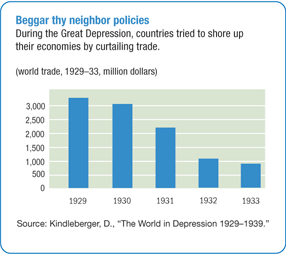
During the Great Depression of the 1930s, countries attempted to shore up their failing economies by sharply raising barriers to foreign trade, devaluing their currencies to compete against each other for export markets, and curtailing their citizens' freedom to hold foreign exchange. These attempts proved to be self-defeating. World trade declined sharply (see chart below), and employment and living standards plummeted in many countries.
This breakdown in international monetary cooperation led the IMF's founders to plan an institution charged with overseeing the international monetary system—the system of exchange rates and international payments that enables countries and their citizens to buy goods and services from each other. The new global entity would ensure exchange rate stability and encourage its member countries to eliminate exchange restrictions that hindered trade.
The Bretton Woods agreement
The IMF was conceived in July 1944, when representatives of 45 countries meeting in the town of Bretton Woods, New Hampshire, in the northeastern United States, agreed on a framework for international economic cooperation, to be established after the Second World War. They believed that such a framework was necessary to avoid a repetition of the disastrous economic policies that had contributed to the Great Depression.
The IMF came into formal existence in December 1945, when its first 29 member countries signed its Articles of Agreement. It began operations on March 1, 1947. Later that year, France became the first country to borrow from the IMF.
The IMF's membership began to expand in the late 1950s and during the 1960s as many African countries became independent and applied for membership. But the Cold War limited the Fund's membership, with most countries in the Soviet sphere of influence not joining.
Par value system
The countries that joined the IMF between 1945 and 1971 agreed to keep their exchange rates (the value of their currencies in terms of the U.S. dollar and, in the case of the United States, the value of the dollar in terms of gold) pegged at rates that could be adjusted only to correct a "fundamental disequilibrium" in the balance of payments, and only with the IMF's agreement. This par value system—also known as the Bretton Woods system—prevailed until 1971, when the U.S. government suspended the convertibility of the dollar (and dollar reserves held by other governments) into gold.
The end of the Bretton Woods System (1972–81)
Video (3:29): Former U.S. President Richard Nixon announces end of dollar link to gold
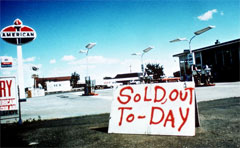
U.S. gas station during the 1970s oil price shock.
By the early 1960s, the U.S. dollar's fixed value against gold, under the Bretton Woods system of fixed exchange rates, was seen as overvalued. A sizable increase in domestic spending on President Lyndon Johnson's Great Society programs and a rise in military spending caused by the Vietnam War gradually worsened the overvaluation of the dollar.
End of Bretton Woods system
The system dissolved between 1968 and 1973. In August 1971, U.S. President Richard Nixon announced the "temporary" suspension of the dollar's convertibility into gold. While the dollar had struggled throughout most of the 1960s within the parity established at Bretton Woods, this crisis marked the breakdown of the system. An attempt to revive the fixed exchange rates failed, and by March 1973 the major currencies began to float against each other.
Since the collapse of the Bretton Woods system, IMF members have been free to choose any form of exchange arrangement they wish (except pegging their currency to gold): allowing the currency to float freely, pegging it to another currency or a basket of currencies, adopting the currency of another country, participating in a currency bloc, or forming part of a monetary union.
Oil shocks
Many feared that the collapse of the Bretton Woods system would bring the period of rapid growth to an end. In fact, the transition to floating exchange rates was relatively smooth, and it was certainly timely: flexible exchange rates made it easier for economies to adjust to more expensive oil, when the price suddenly started going up in October 1973. Floating rates have facilitated adjustments to external shocks ever since.
The IMF responded to the challenges created by the oil price shocks of the 1970s by adapting its lending instruments. To help oil importers deal with anticipated current account deficits and inflation in the face of higher oil prices, it set up the first of two oil facilities.
Helping poor countries
From the mid-1970s, the IMF sought to respond to the balance of payments difficulties confronting many of the world's poorest countries by providing concessional financing through what was known as the Trust Fund. In March 1986, the IMF created a new concessional loan program called the Structural Adjustment Facility. The SAF was succeeded by the Enhanced Structural Adjustment Facility in December 1987.
Debt and painful reforms (1982–89)
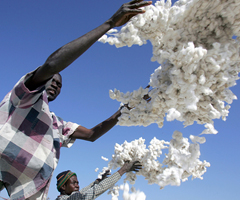
Cotton harvest in Burkina Faso: Prices for commodities from developing countries slumped in the early 1980s because of recessions in industrial countries (photo: Issouf Sanogo/AAFP)
The oil shocks of the 1970s, which forced many oil-importing countries to borrow from commercial banks, and the interest rate increases in industrial countries trying to control inflation led to an international debt crisis.
During the 1970s, Western commercial banks lent billions of "recycled" petrodollars, getting deposits from oil exporters and lending those resources to oil-importing and developing countries, usually at variable, or floating, interest rates. So when interest rates began to soar in 1979, the floating rates on developing countries' loans also shot up. Higher interest payments are estimated to have cost the non-oil-producing developing countries at least $22 billion during 1978–81. At the same time, the price of commodities from developing countries slumped because of the recession brought about by monetary policies. Many times, the response by developing countries to those shocks included expansionary fiscal policies and overvalued exchange rates, sustained by further massive borrowings.
When a crisis broke out in Mexico in 1982, the IMF coordinated the global response, even engaging the commercial banks. It realized that nobody would benefit if country after country failed to repay its debts.
The IMF's initiatives calmed the initial panic and defused its explosive potential. But a long road of painful reform in the debtor countries, and additional cooperative global measures, would be necessary to eliminate the problem.

No comments:
Post a Comment